When Australians are under pressure, politicians talk about China. When working people are squeezed, Parliament fills with cost-of-living language. When property investors feel threatened, "negative gearing" dominates. None of this is random. It is measurable, predictable, and — as 125 years of the national archive shows — it follows a structural logic that has nothing to do with what's actually happening overseas.
The Framework
Political language as a system symptom
The standard assumption is that political discourse reflects external reality. If politicians are alarmed about China, it's because China is alarming. If the cost of living dominates Question Time, it's because prices are rising. Sometimes that's true. But a systematic analysis of the Trove newspaper archive from 1900 to 1955 and twenty years of parliamentary Hansard from 2006 to 2025 reveals a more fundamental pattern: the language the political system produces is shaped at least as much by the internal health of Australian institutions as by anything happening in the world.
The research uses the CAMS framework — Civilizational Analysis and Measurement System — which scores Australian institutions across eight societal domains each year from 1875 to 2026. Each domain is rated on coherence, capacity, stress, and abstraction. The scores are averaged across five independent assessors (the CAMS5 ensemble) to reduce scorer bias. Two nodes matter most for this analysis: the Hands node (labour and working-class institutions — wages, employment security, union legitimacy, economic participation) and the Stewards node (capital and asset-owner institutions — property, business viability, investment confidence).
When either node deteriorates, the political system produces a predictable discourse response. When both deteriorate simultaneously, both responses fire at once — the condition of maximum political instability. When only one node is stressed, only its register dominates. The pattern repeats across a century and a half with extraordinary consistency.
Finding One
The China threat is largely a mirror, not a window
Between 2006 and 2016, threat-coded China discourse in the House of Representatives averaged less than one reference per million words. Between 2017 and 2021 it averaged 21 per million — a 37-fold increase. The peak came in 2021, during the AUKUS announcement, when Australia's institutional coherence index (τ) had been falling for four years.
Did the 37-fold surge correspond to a 37-fold increase in threatening Chinese behaviour? No. What it corresponded to was a deterioration in Australia's institutional coherence that began two to three years earlier. The statistical relationship runs one way: CAMS metrics predict subsequent China discourse (r = −0.74 to −0.76 at a two-to-three year lag); China discourse does not predict subsequent CAMS metrics.
This doesn't mean the parliamentary concerns about China were fabricated. Real events — AUKUS, Belt and Road tensions, COVID-era disputes — played a role. But the underlying volume and trajectory of threat-coded language was disproportionate to those events and followed domestic institutional deterioration with precision. The Albanese government's diplomatic re-engagement with China from 2022 onward brought the foreign register back down — without any measurable effect on the domestic grievance register, which continued rising regardless.
A historical parallel reinforces the point. Looking at the Trove archive from 1900 to 1955, threat-coded China language in Australian newspapers was strongest during the Federation boom (1900–1913) when the CAMS Hands and Stewards nodes were both healthy — not during the Depression or the World Wars when they weren't. In periods of high institutional confidence, Australia expressed its foundational exclusionary ideology (the White Australia Policy) loudly and from a position of strength. This is the prosperity-ideology effect: confident systems project their exclusions outward; stressed systems turn inward.
| Regime | CAMS conditions | Discourse character | Australian examples |
|---|---|---|---|
| Prosperity Ideology | High coherence, strong institutions | Confident, elaborated ideological exclusion — louder prejudice from a position of strength | White Australia discourse 1900–1913; Menzies-era anti-communism |
| Stress Projection | Falling coherence, declining institutional capacity | Elevated threat-coded foreign discourse; leadership churn; political instability | Sinophobia surge 2017–2021; post-WWI Red Scare 1919–22 |
| Event Response | Mixed; exogenous shock dominant | Sharp, contemporaneous spike that decays quickly once the event passes | Russophobia surge after February 2022 Ukraine invasion |
Finding Two
The economy sends a two-year warning before the political storm
Alongside the foreign-discourse analysis, a parallel experiment tracked the domestic register: working-class grievance language in the Trove archive (1900–1955) and in parliamentary Hansard (2006–2025). The grievance lexicon included "cost of living", "battler", "working families", "real wages", "housing affordability", "gig economy", "wage theft", and "robodebt", among others.
The central finding: the CAMS Hands node — measuring the coherence, capacity, and stress of labour and working-class institutions — predicted parliamentary grievance discourse two years in advance, with a correlation of r = −0.75 (p = 0.0003). That is the strongest single predictor in the entire dataset.
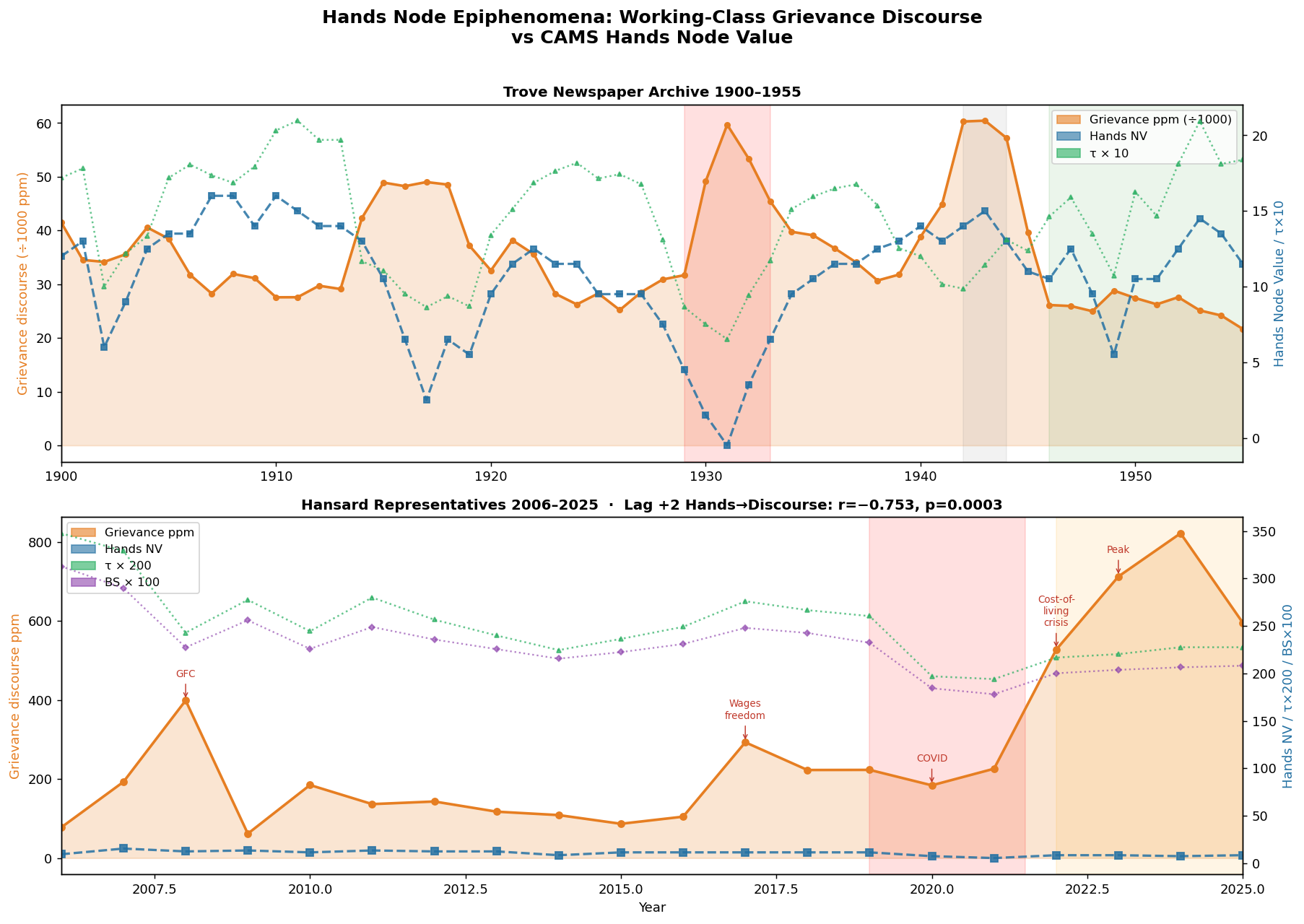
The mechanism is concrete. In 2020, the CAMS5 ensemble scored the Hands node at a stress level of 8.0 and a Node Value of 3.0 — its lowest since the 1990–92 recession, and a combination seen outside the Depression years in only three other periods in the 150-year record. Two years later, in 2022, parliamentary grievance discourse surged. By 2024 it had reached 822 references per million words — a level that, standardised against its own baseline, slightly exceeds the 1931 Depression peak.
Comparing the two historical episodes in standardised units cuts through the difference in absolute scale between a digitised newspaper archive and modern Hansard:
This does not mean conditions in 2024 were worse than the Depression — they manifestly were not. The Hands Node Value in 1931 was −4.5; in 2020 it was 3.0. What the standardised comparison shows is that the contemporary parliamentary register amplifies a given level of institutional stress more loudly relative to its own baseline. A 24-hour media cycle, social media, and a more adversarial parliamentary culture all lower the floor and raise the ceiling for grievance expression.
A robustness check confirmed the result is not an artefact of a single scandal: removing "robodebt" from the grievance vocabulary reduced the 2022–24 peak by only 5–12%, leaving the core surge intact across cost-of-living, housing affordability, real wages, gig economy, and precarity vocabulary.
Finding Three
Different stresses produce different political languages
The political system doesn't produce one kind of anxiety — it produces several, and the register that dominates depends on which institutional domain is under stress.
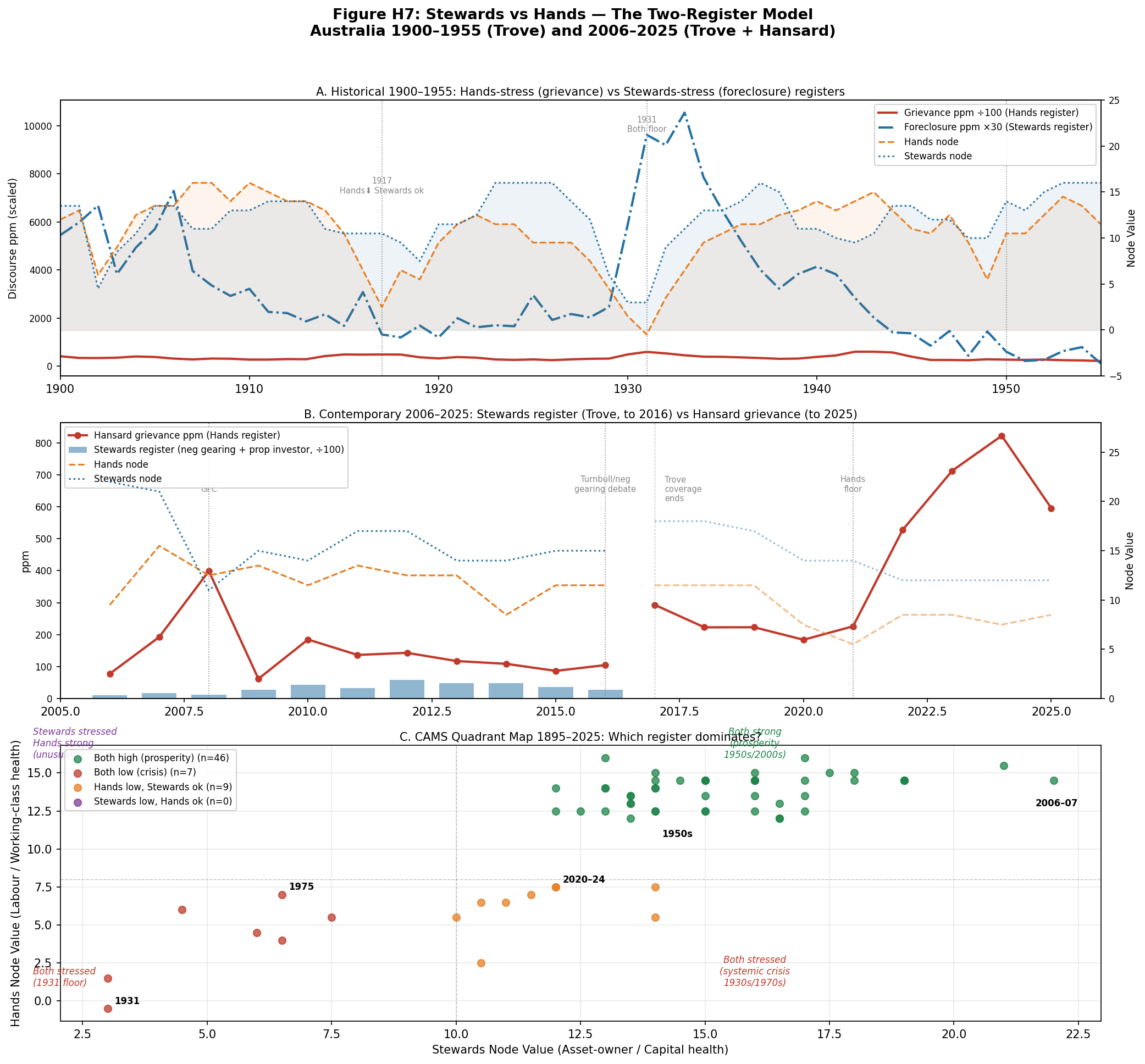
When the Hands node deteriorates — labour institutions weakening, working people squeezed — the language that emerges is about "battlers", "working families", "real wages", and "cost of living". When the Stewards node deteriorates — asset-owner and capital institutions under pressure — a different language appears: "foreclosures", "small business", "negative gearing", "red tape". These two registers are empirically separable. Foreclosure discourse in Trove correlated with Stewards node deterioration (r = −0.26) but was essentially uncorrelated with Hands deterioration (r = −0.01). The grievance vocabulary shows the reverse pattern.
| Period | Hands node | Stewards node | Dominant discourse |
|---|---|---|---|
| Depression 1930–33 | Floor (NV −4.5 in 1931, stress 9.8) | Floor (NV −4.1 in 1931, stress 9.4) | Both registers fire — maximum political instability |
| WWI 1916–17 | Low (NV 4–6, stress 7.0) | Moderate (NV 7.5–9.5, stress 5.2) | Labour register only — class grievance, conscription battles |
| Menzies boom 1950–59 | Strong (NV 11.9, stress 2.8) | Strong (NV 12.5, stress 3.2) | Neither dominant — low political temperature |
| Howard boom 2003–07 | Good (NV ~8–10) | Strong (NV ~10–11) | Stewards register — aspirational voters, property, WorkChoices |
| GFC 2008–09 | Moderate (NV ~9) | Drops to ~8 | Both registers briefly activated |
| 2020–25 | Stressed (NV 3.0 in 2020, stress 8.0) | Moderate and stable (NV 7.5, stress 5.2) | Labour register only — cost of living dominates; asset-owners relatively protected |
What makes the 2020–21 period historically unusual is not the absolute depth of the Hands floor — the 1990–92 recession was worse in absolute terms (Hands NV 0.0 in 1990–91). What is unusual is the asymmetric character: Hands stress reached 8.0 while the Stewards node held at moderate stress (5.2). This combination — high Hands stress alongside low Stewards stress — has appeared in only three periods across the full 150-year CAMS record: WWI (1916–17), the 1982 recession, and 2020–21. In the Depression and the 1990s recession, both nodes were severely stressed at once.
The consequence in 2020–25 was exactly what the model predicts: the labour register dominated while the capital register was structurally quiet. Working people faced stagnant real wages, housing unaffordability, and gig-economy insecurity; property prices stayed elevated, superannuation recovered after COVID, and business profits held up. One node floored, one standing — one register at maximum volume, the other silent.
Finding Four
We fight loudest for things we haven't secured yet
A symmetric test asked whether good times produce confident, aspirational labour language — the mirror image of the grievance finding. Three phrases were tracked across the Trove archive 1900–1955: "eight hour day", "living wage", and "full employment".
The result was a correlation of r = +0.001 — a statistical null. Positive labour vocabulary does not rise with Hands node health. But the null is the finding.
"Eight hour day" peaked in 1911 (Hands NV ≈ 11.5) — during the Federation-era campaigns to extend it state by state, when it was still contested law. "Living wage" peaked in 1919 (Hands NV 6.0) — during the post-war labour militancy when it was an active political demand, not a settled right. "Full employment" peaked in 1945 (Hands NV 10.5) — during the White Paper debate, when the Keynesian commitment to it was still being argued.
By the 1950s — the highest Hands decade in the ensemble record, with a mean Node Value of 11.9 and a stress score of 2.8 — all three terms had fallen to their historic minimum. The eight-hour day was statutory law. The living wage was embedded in the arbitration system. Full employment was accepted policy. There was nothing left to campaign for.
This creates a fundamental asymmetry. Grievance discourse responds monotonically to deteriorating conditions — it rises as things get worse. Aspirational discourse responds to the contest — peaking during the active struggle, then falling silent at the moment of victory.
The same asymmetry appears on the capital side. "Negative gearing" discourse in Australian newspapers was not highest during the Howard boom of 2003–07, when property investors were most secure. It was highest in 2010–2016, when Labor was threatening to reform the policy. In 2006, at the peak of the property boom (Stewards NV ≈ 10–11), negative gearing attracted modest discussion. In 2013, when the policy was under active political threat, it was five times more prominent. The vocabulary of defence fires during contestation — not at peak security, and not at peak distress.
What This Means for Australia in 2026
Recovery is underway — but the discourse lags
The CAMS5 ensemble shows an important development that postdates the worst of the cost-of-living crisis. The Hands node has recovered significantly: from a Node Value of 3.0 in 2020 to 8.5 by 2025–26. It now marginally exceeds the Stewards node (7.5) — for the first time since the late 1940s, when postwar reconstruction and full employment policy briefly gave labour institutions the stronger position. The gap that opened so dramatically in 2020 has closed.
On the two-year lead time established by the data, this Hands recovery — if it is sustained — should register as easing grievance discourse by 2027–28. That is a falsifiable prediction. If parliamentary cost-of-living language is still rising at the same rate in 2028, it would suggest either that the Hands recovery is shallower than the ensemble scores indicate, or that the two-year lag operates differently in the contemporary parliamentary environment. Either way, the forecast is testable.
The framework also carries an early-warning function for the other register. If Australian property prices fall significantly, business insolvencies rise, or investment confidence deteriorates — none of which has happened at scale — the CAMS Stewards node would be expected to deteriorate, activating the capital register alongside the labour register. That would reproduce the double-stress configuration last seen in the Depression and the early 1990s recession: foreclosure language and cost-of-living language rising simultaneously, both registers at volume. The model does not predict this is imminent; it describes what the structural signature would look like if it were approaching.
What the research cannot tell us
The framework is structural, not political. It identifies conditions that generate discourse; it does not identify which party benefits, which policies cause the conditions, or whether any particular government deserves credit or blame. A Hands node recovery under Labor looks the same to the model as one under the Coalition. A Stewards node collapse triggered by a global financial crisis looks the same as one triggered by domestic policy failure.
The framework also cannot tell us whether elevated foreign-threat discourse is strategically deployed or genuinely felt. What it can tell us is that the volume of that discourse correlates more strongly with domestic institutional health than with the behaviour of foreign states — and that the diplomatic re-engagement with China in 2022–25 reduced the foreign register without touching the domestic one. These are the empirical constraints within which any political interpretation must operate.
Methodology and Data Sources
Trove archive: NLA Trove API v3, newspaper category, 1900–1955. Frequencies normalised against a baseline word ("the") to produce parts-per-million (ppm) measures comparable across years. Single-phrase queries used throughout; results summed before normalisation to avoid OR-query corpus saturation.
Hansard: XML files from the Open Australia Foundation covering House of Representatives debates 2006–2025. Word-occurrence ppm calculated against total word counts per year.
CAMS data: CAMS5 ensemble means 1875–2026 — five independent scorers averaged at the node-year level. Eight nodes (Helm, Shield, Lore, Stewards, Craft, Hands, Archive, Flow), each scored on Coherence, Capacity, Stress, and Abstraction. Node Value and Bond Strength computed from ensemble means. The coherence ratio τ and entropy ε used in the Sinophobia analysis come from the aus_annual.csv CAMS series.
Statistics: Spearman rank correlation, OLS regression, Mann-Whitney U, lag-correlation analysis, z-score normalisation. All results quoted pass p < 0.05 unless noted as marginal or null. The Hansard regression (n ≈ 20 years) is noted as suggestive structural evidence rather than definitive proof; replication on longer or broader corpora remains desirable.
Conducted: May 2026, Epiphenomenon@Trove project.
Full technical report: Epiphenomenon@Trove — Grok Report v3 (Word)