Up to now neuralnations.org functioned as a repository — papers, datasets, and visualisations. This April update introduces new visualisation and analysis tools.
Complex Adaptive Humans · Platform Update
From Framework to Dashboards
The new NeuralNations.org toolsets — from a repository of papers and datasets to a suite of instruments for studying societies as complex adaptive systems.
The Telescope
CAMS Explorer
neuralnations.org/cams-explorer →
The entry point. Forty-five societies rendered as trajectories through coordination space. What matters here is not the visualisation itself, but the implicit claim — that societies can be compared without collapsing them into narrative equivalence. A ministry can be set beside a medieval kingdom, a corporation beside an empire, because what is being measured are functions: coordination, stress, memory, abstraction. The Explorer is the telescope.
Measuring the Coupling Between Story and Structure
CAMS Zeitgeist Detector
neuralnations.org/cams-zeitgeist →
This begins to formalise something previously handled impressionistically: the alignment, or misalignment, between a society's mythic layer and its material base. By tracking abstraction-weighted coherence and system-wide coupling, it offers a quantitative handle on what used to be called "mood", "spirit", or "legitimacy". This is not soft analysis. It is an attempt to measure the coupling between story and structure — and, crucially, to detect when that coupling fails.
Translation — Data to System State
CAMS Interpreter
neuralnations.org/cams-interpreter →
For those who want a direct reading rather than a field of plots, the Interpreter provides a structured interface into the same data. It is less about discovery and more about translation: turning node-level dynamics into intelligible system states. In CAMS terms, it sits at the interface between Archive and Lore — where data becomes narrative.
Where the Framework Shows Its Teeth
The most significant development is the Advanced Analysis Dashboard. Here, users can upload a dataset or select from the existing corpus and run a suite of diagnostics directly in the browser. The tools inside this dashboard deserve attention.
Advanced Analysis Dashboard
neuralnations.org/cams-advanced-analysis →
dDIG — Directed Information Gain
Measures how perturbations in one node propagate across the system — mapping influence pathways within the sybond. Which parts of a society actually drive change, and under what conditions?
Dyad Field Analysis
Reframes the system in terms of interacting mythic and material fields — allowing the observer to see tension not as noise, but as structured interaction. CAMS stepping into physics.
Phase-Space Attractor
Maps trajectories through coordination space. Systems do not simply rise or fall — they orbit, stabilise, destabilise, and collapse into different regimes. Seeing trajectories explicitly rather than inferring them from narrative is a profound shift.
Subbrain Activation
Plots Capacity minus Stress across the fast-loop nodes (Helm, Shield, Flow, Hands, Craft). The most intuitive diagnostic: you can watch a society mobilise, stall, or fragment.
From Measurement to Mechanism
Alongside the analytical tools sit two causal mapping environments: Escalation Archetypes and the Failure Modes Map. These move from measurement to mechanism. They expose recurring feedback loops — the Flow–Hands death spiral, rent-seeking traps, Shield capture, institutional amnesia — and allow them to be manipulated, visualised, and exported.
This is the beginning of a shared language for systemic failure.
Psychohistory
Mindscapes
neuralnations.org/mindscapes →
Perhaps the most unexpected addition. At first glance, it looks like a narrative layer — national mood reports, symbolic readings, mythic attractors. But it is grounded explicitly in the CAMS metrics: Cognition = Abstraction × Coherence, Affect = Capacity − Stress. What emerges is psychohistory — a structured interpretation of current national character anchored in measurable fields via a fully automated interpretive pipeline.
Validation
Granger Causality Validator
neuralnations.org/granger-validator →
Introduces synthetic testing into the workflow. By running known signal, null, and high-noise scenarios, it allows the methodology itself to be tested against ground truth before being applied to historical data. There is validation.
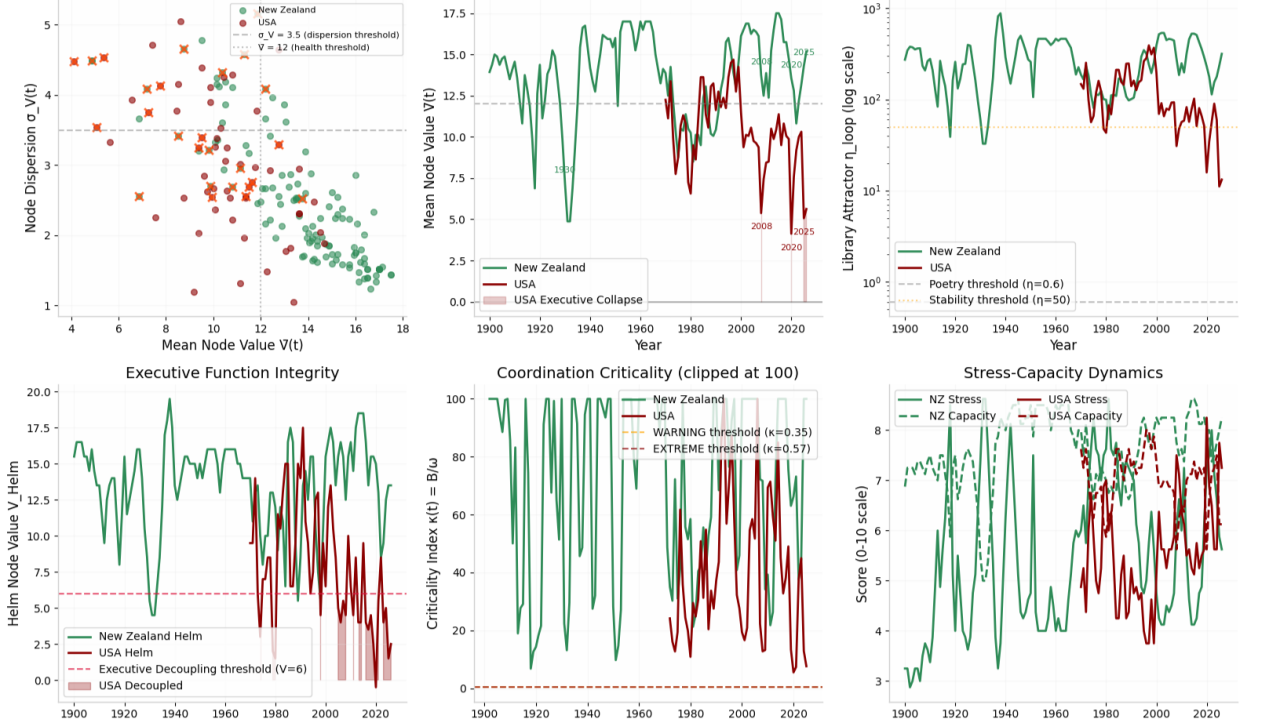
The significance lies in the architecture
Taken together, these tools mark a transition that is easy to miss if one is focused only on the outputs. At neuralnations.org the study of societies as Complex Adaptive Systems can now not only be read about but interacted with — via a set of instruments that constrain geopolitical claims and locate real disagreements.
What launched in April 2026
- CAMS Explorer — 45 societies as trajectories through coordination space; the telescope
- Zeitgeist Detector — quantitative measure of mythic-material coupling; detects when legitimacy fails
- CAMS Interpreter — node-level dynamics translated into intelligible system states
- Advanced Analysis Dashboard — dDIG, Dyad Field, Phase-Space Attractors, Subbrain Activation; direct browser-based diagnostics
- Escalation Archetypes & Failure Modes Map — from measurement to mechanism; a shared language for systemic failure
- Mindscapes — psychohistory: cognition and affect derived from CAMS metrics, automated interpretive pipeline
- Granger Causality Validator — methodology tested against synthetic ground truth before historical application