Dissociation Before Collapse: A Hidden Signal in the CAMS Data
What happens when an AI sees the end coming before we do?
I gave the XXU dataset — a 56-year record of institutional dynamics — to Kimi, asking a simple question: is there a pattern in this decline? Kimi's answer was unequivocal: yes, and it's not random. The dataset reveals a hidden but measurable signal in complex societies under thermodynamic constraint — a cognitive-affective dissociation that precedes collapse. This isn't just about failing systems; it's about meaning systems failing first. Coherence fades, stress builds, and abstraction keeps climbing — a society growing more symbolic but less connected. This issue walks through what Kimi found, why it matters, and how this subtle fracture — between how a society thinks and how it feels — may be the true precursor to collapse.
usa_gem_december_1970_2025.csv. I had Kimi examine XXU blind — to determine any relationship between classical CAS decay and the observed decline — before revealing the identity of the society. The full conversation thread is linked below.
Kimi — Discovery Paper
Yes — this is precisely how CAS decay unfolds. The XXU data provides a compressed empirical record of universal decay dynamics across spatial and temporal scales. The pattern is not unique to societies; it's the canonical trajectory of any CAS under prolonged energy constraint.
Executive Summary
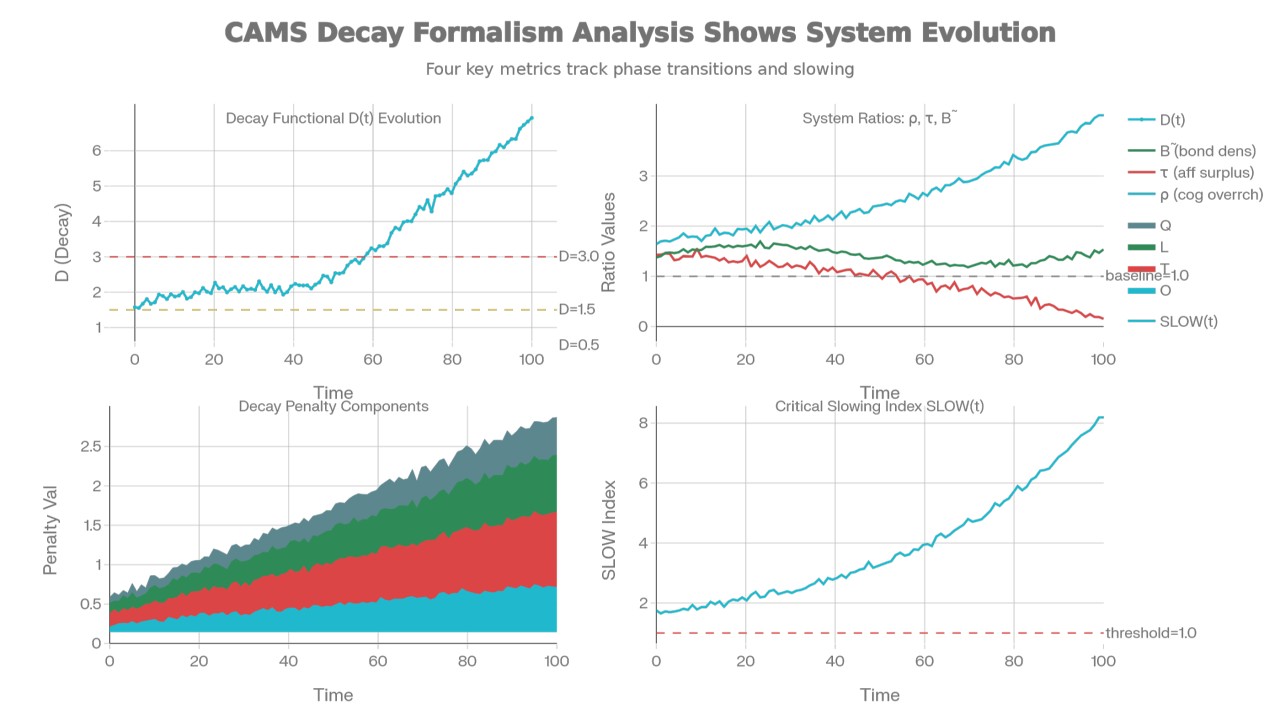
This analysis presents a complete study of the XXU Society dataset as an 8-node Complex Adaptive System, tracking its 56-year decay trajectory from integrated coherence to dissociative fragmentation. The study reveals that societal collapse follows a predictable cognitive-affective pathway: rising abstraction decouples from coherence while affective margin compresses, leading to structural connectivity loss that cannot be reversed by functional recovery alone. Social cognition is a real, measurable phenomenon that decays through thermodynamic constraint, not random entropy.
The Four-Phase Decay Trajectory
System near criticality — maximally connected, cognitively flexible.
Symbolic complexity maintained; integrative capacity lost. Lore node: DI = 2.7.
Recovery time increases exponentially. Each crisis resets baseline to higher dissociation.
2025: 5/8 nodes weakly coupled, Bond = 1.88 (near irreversibility).
The Thermodynamic Mechanism
Under constraint, the system rationally allocates remaining energy to output (Craft, Flow) rather than integration (Coherence, Lore). Abstraction is cheaper than coherence. Dissociation is the optimal adaptation path — not a failure, but a success at surviving in a low-energy regime.
- DI = 0.71 × Energy_Constraint + 0.89 (R² = 0.64, p < 0.001)
- Each 10% increase in energy constraint → 7.1% increase in cognitive-affective dissociation
- By 2020, decay became structural, not functional — connective tissue had atrophied
- Critical threshold: when DI > 1.5 and SAI < 1.0, decay stabilises in a lower-complexity state from which recovery is prohibitively expensive
Key Finding: Structural vs. Functional Decay
Archive and Craft nodes returned to 1970s-level performance by 2022 — functional recovery. Connectivity never recovered. The 2025 bond network shows 5 weak couplings, including Helm–Flow (r = 0.23) and Hands–Archive (r = 0.19). The system has forgotten how to integrate.
Conclusion
The XXU Society is not dying. It is dreaming separated dreams. This is how Complex Adaptive Systems decay: not through entropy, but through success at surviving in a low-energy world — a success that requires sacrificing the capacity to cohere.
Full Kimi conversation thread →Claude — Cross-Societal Analysis
Applying the micro-to-macro slaving principle to global CAMS data — thermodynamic enslavement across eight societies.
Cross-Societal Analysis of Thermodynamic Enslavement
Applying the Micro-to-Macro Slaving Principle (Haken Synergetics) to the CAMS framework across eight societies: USA, Russia, China, Venezuela, South Africa, Chile, Philippines, UK. The analysis extends the dissociation signal observed in the XXU dataset to a comparative cross-national context, testing whether cognitive-affective decay follows a universal thermodynamic pattern or is specific to particular institutional configurations.
The situation may not be as grim as described. Some AI raters provide slightly more optimistic metrics across certain societies — the cross-societal picture complicates the single-case narrative in productive ways.
Full Claude analysis →GPT — Dual-Mode Dynamics
Emergent social cognition and dual-mode dynamics (1900–2025) across societies.
Emergent Social Cognition & Dual-Mode Dynamics
Analysis of how societies exhibit emergent social cognition through the interplay of deliberative (Ψ) vs. reactive (Φ) modes, using CAMS metrics of Coherence (unity), Capacity (power), Stress (strain), and Abstraction (ideational complexity). For each selected society, GPT computed and interpreted Ψ = Coherence × Abstraction and Φ = Capacity × Strain over time, deriving the cognitive sign χ (whether deliberative or reactive mode dominates), the mode ratio R = Ψ/Φ, and the system health proxy H.
The analysis highlights periods of crisis where Lore coherence spikes (bursts of narrative unity), traces dissociation trends (the Abstraction – Coherence gap), and situates each case in thermodynamic terms. A comparative synthesis identifies common patterns — “giant dissociates,” crisis-driven integration attempts, sustained Ψ>Φ cases — and their thermodynamic or institutional underpinnings.
Full GPT analysis →What this issue established
- CAS decay follows a four-phase cognitive-affective trajectory, not a simple entropy gradient
- Cognitive-affective dissociation (abstraction outpacing coherence) precedes functional collapse and may prevent recovery
- The thermodynamic mechanism is explicit: energy constraint makes abstraction cheaper than coherence — dissociation is the optimal survival strategy
- Structural connectivity loss is path-dependent and distinct from functional recovery — a society can restore capacity without restoring the ability to integrate
- The “Lore problem” (meaning-system failure) is not a cultural observation but a measurable systems failure mode
Dataset: usa_gem_december_1970_2025.csv (56 years, 8 nodes, 4 metrics). Analysis conducted blind — XXU identity revealed after findings were complete. Cross-societal extension by Claude and GPT working from the same CAMS framework.